David Keyes | What they forgot to teach you about starting a business with R | RStudio (2022)
videoimage: thumbnail.jpg
Transcript#
This transcript was generated automatically and may contain errors.
I'm David. I run R for the rest of us. I'm here to talk to you about starting a business with R. But here's the thing. I never actually intended to start my own business. And to show you how unintentional my path to doing what I do now has been, let me give you a brief story. In 2015, I was working my last 9 to 5 job. My wife had just started a job at the time. It was a pretty challenging job, but she likes challenging jobs. At the time, we were hoping to have kids, so we were overjoyed when we found out that she was pregnant with not one but two kids. We were going to have twins. Now, at the time, we talked about what to do. I really like kids. I used to be an elementary school teacher, so we decided that I would stay home with our kids and she would continue working.
Now, for those of you who have kids, you might not be surprised to hear that my pre-kid vision of what being a full-time stay-at-home dad would be like was pretty different from the post-kid reality. And so after a few months, my wife very kindly said to me, you know, it's okay if this isn't going to quite work out the way we imagined it might. What happened, though, at the same time was that the challenging job that my wife, Rachel, had started actually came to feel untenable. Having young kids and an incredibly challenging job was just a bit too much. And she ended up leaving that job. So in a few months, we had gone from having two jobs and zero kids to having zero jobs and two kids. And it was at that time I realized, okay, I need to do something to bring in a little income for our family. So I started doing some freelance data analysis work. I was an Excel user at the time. I used Excel for everything. But I got a little bit bored. And I had heard about R. And I had heard that R could, you know, do some nice stuff, automate things, make nice data viz. And I was like, okay, cool, let me learn that.
I taught myself R. And in the process realized, first of all, that I really liked it. And second of all, that there were a lot of people like me who also wanted to learn R. And so it was from that experience that I started R for the Rest of Us. Today, R for the Rest of Us does both education work, we have online courses, trainings for organizations, as well as consulting work. And I'm going to use examples from our business. But this isn't really ultimately a talk about my business. This is a talk about your business.
Why marketing matters
I'm going to focus mostly on marketing, on how to sell your work. And the reason why is it's the thing that people who are thinking about starting their own business ask me the most. They say, David, I want to start my own business, but I have no idea how to find clients. How did you do it? And I know there are some people potentially in the room, maybe you're waiting for the next talk, who are thinking, you know what, I don't actually want to start my own business. Before you run for the doors, I think the reason you might consider staying is that marketing matters, even if you're just working, if even if you aren't working for someone else. So you need to, for example, sell your own work within your own organization. So your boss or your co-workers see what you're capable of, maybe you're making an R package, and you want to get it out into the world, you need to market it. So rather than put our heads in the sand and not do any marketing, let's learn how to do marketing well.
A quick question, if you would say that you like marketing, would you go ahead and raise your hand? So I see a handful, maybe like 10 max. Not that many people in the room, I would say overall, say they enjoy marketing. And I think the reason why is this. Technical people like us tend to be pretty allergic to marketing. And I know that because I, in the past, very much felt like this. We think, okay, if I write really good code, that should be enough. I shouldn't have to go out and sell it, right?
What I've realized is that what, another thing I've come to realize in the last few years is that when people say that they don't like marketing, the marketing they're thinking of is often kind of like this, right? Like think about stuff you've seen on social media with a ton of hashtags linked to who knows where, trying to sell who knows what, right? That type of like sleazy marketing. But what I've come to realize in running R for the rest of us is that marketing can actually look more like this, can look like education, it can look like teaching. And so I think when you do marketing well, it doesn't actually even necessarily seem like marketing.
marketing can actually look more like this, can look like education, it can look like teaching. And so I think when you do marketing well, it doesn't actually even necessarily seem like marketing.
Marketing as education
Let me give some examples from other people who run kind of consulting businesses of how they talk about marketing and ways that their approach also shows up in what we do with R for the rest of us. So Paul Miners was asked how he does marketing, how he finds his clients. He's a consultant who trains on like Asana and Pipe Drive. The details don't really matter, but what he said is, the way I do marketing is simple. I go to where my ideal clients are and I'm helpful. And so with R for the rest of us, what that's meant is we go to where people are, which probably won't be a huge surprise for folks here, is Twitter. That's where the R community tends to show up. And the way we're helpful is every day for the last three and a half years, we have tweeted out one tip every day at 7.30 a.m. Sometimes things that we create, oftentimes things that other people create. And so through doing that, we've been able to build up a following of over 15,000 followers, which becomes useful in ways I'll talk about shortly.
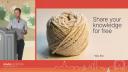
Wes Boss talks about his approach being this. Share your knowledge for free with no strings attached. On the R for the rest of us website, we have a blog. There are a bunch of posts. This is an example of one on how to set up Git and GitHub if you're working with R. And I wrote it, first of all, because it was something I struggled with, so I figured other people probably would as well. People can go on the R for the rest of us website, can read this for free. They don't have to pay us anything. And I'm totally fine with that. I want to give that value.
And the thing with offering things for free is that this is taken from Adam Latham, who says that giving away your work for free is like compressing a spring and that spring releases when you finally have something up for sale. So rather than thinking about marketing as going out and saying, hey, I'm selling this, I'm selling that, it's much better if you can go out and offer value, offer things for free, and once you get that goodwill, hopefully get some following as well, then you can offer things that are paid. So this is an email that I send out twice a year announcing the start of a program called R in Three Months, where we do a three-month training program for folks. And when I send that out, because we've built up that goodwill, because we've offered things for free, people are more interested in signing up.
Lesson one: go deep, not broad
I'm going to now offer kind of four lessons that have been really useful for me in thinking about how to find clients. So if we think about, okay, marketing done well generally looks like kind of education, what are some more specific ways that we can look for clients? So the first lesson that I'm going to offer is to think about going deep, not broad. So people will sometimes say to me, hey, I really like what you're doing, you know, I like teaching too, like I'd love to start a business training people to learn R. And they'll say, and I'll ask, you know, okay, great, like who are you thinking about trying to work with? And I'll say, well, anybody. But here's the problem. If you try to speak to everyone, no one will listen. Your message is just too general, and people don't, it's not going to resonate if it's overly general.
So instead, what you really want to do is find your people. In business speak, people will talk about niching down, finding a niche that you can work in. And so with R for the rest of us, even the name of the business, that was like my first attempt to kind of niche down. I'm not necessarily trying to train everybody, I'm training the rest of us. Now, of course, everybody interprets that slightly differently, but generally speaking, what I think of as our kind of ideal audience is people who want to learn R, but are intimidated by it. And I pitch everything to that specific audience. On marketing emails that go out, in the footer of those emails, this is what the text says. Think you know what an R user looks like? I'm probably not what you have in mind. Not a hardcore quant. I won't jump on you for any small mistake. And I want to help others avoid the pain. And you can see through this language, I am trying to identify this is the type of person that I think R for the rest of us is best for.
It's not that other people couldn't. I think anybody can learn R through the materials that we offer. But this is really like our ideal audience. And so with some people, that's not going to resonate, and that's okay. But for other people, that really will resonate, and they'll be inclined to learn R through us, whereas a more general framing probably wouldn't appeal to them. In addition to turning people on, having language that speaks to certain people, it's really important also to turn people off. And I know that sounds counterintuitive, because you think, well, you want to have an offering that's going to be, you know, like applicable to anybody. But it actually doesn't work very well. And turning people off is a really effective strategy to help you identify the niche that you do want to work in.
So I'm in the process of writing a book. It's called R Without Statistics, which is my attempt to both say what the book is, but also what it's not. It's broadly speaking a book about kind of quirky, interesting things that you can do with R that don't involve any complex statistics. So when I tweeted about this in March, I got this feedback. Luis wrote, marketing tip, the label will create a huge barrier among statisticians and scholars. And I put this up not in any way to disparage Luis. Like, I really appreciate the feedback. But the thing is, that's not my target audience. Statisticians and scholars are, I mean, maybe they'll read the book. I'm more than happy for them to read the book. But that's not the audience that I'm going for. And by calling it R Without Statistics, I'm intentionally trying to turn some people on, but also turn some people off.
Lesson two: focus on results
Lesson two, focus on results. So it's really easy for those of us who are technical to get really into the tools that we use. You know, we want to talk about this new package or this new function that I learned. For clients, though, what they really care about is getting to the goal. As an example of this, two or three years ago, a potential client came to us from the state of Connecticut. And they said, David, we have to produce 169 reports, one for each town in the state of Connecticut. We use Excel. We have no idea how this is going to work. I've heard that R can maybe do this. In my head, what I'm thinking is, yeah, of course, like R Markdown parameterized reporting and page down package. But that's not at all what I'm going to say to them. Instead, I'm going to frame it as, yeah, we can help you to automate this. We can do it more efficiently. And we'll also do it in a way that there will be fewer copy-paste errors. They care about that end result. They don't care about the tools generally that we're using.
So we did that report, and this is what we ended up producing entirely with the tools that I talked about. On the R for the rest of us website, on the consulting page, the headline is Communicate More Effectively and Efficiently. Note that I'm not talking about any R packages, anything like that. I'm talking about how to communicate effectively and efficiently, which is language that I think will resonate with my clients and potential clients.
Lesson three: make your client the hero
Lesson three is to make your client the hero. It's really easy when you're developing marketing materials early on to say, I can do this, I can do that. But really, the way you want to position yourself is as the guide that is helping your client, but the client remains the hero of the story.
So this is a report we did in 2020, maybe 2021, on census outreach efforts in the 2020 census. And when I write about this, I have a case study on the R for the rest of us website. Here's what I say. The 52 reports helped Oris Impact and the Democracy Funders Network, that was our client, to achieve their goals and more. And they did this without the agonizing manual work. So I'm talking about, I'm framing it in a way that I think will resonate with potential new clients, and I'm framing the client here as the hero, not saying, you know, we did this. I'm saying we helped them to make these reports without that agonizing manual work.
Lesson four: relationships matter most
Last lesson is this. Relationships matter more than technical skills. When you're starting out, it's really easy to think, you know, I just got to, like, tweak this one bit of CSS on my website. To be honest, that doesn't really matter that much when you first start out, because your first clients are almost certainly going to come from people you know. At the same time that you cultivate existing relationships, it's important to cultivate new relationships. So for me, what this often looks like is I'll see people tweet about art for the rest of us. And I'm really grateful when they do. Of course, it's like fantastic marketing for me. So I'll follow up with them, and I'll say, you know, thank you for doing that. I really appreciate that. And I'll do something like give them a free course. And so by doing that, you know, I make, hopefully, cultivate a good relationship, but then also maybe this person signs up for another course or are in three months or mentions it to a colleague. I think it can lead to other things in the future.
So to wrap up, I want to leave you with this idea. You are not me. I've given examples here, and I've drawn lessons from the work of art for the rest of us. But it's really important to focus not so much on the specific tactics that we've used, rather focusing on the larger lessons. As an example, if you were thinking about becoming a consultant working with data science teams, you'd probably talk more about the technical side of things than we tend to. But you still want to do it in a way that frames the conversation around the end result as opposed to an overemphasis on the technical tools themselves. So I hope I have left you with the idea that it is possible to sell your work without selling your soul.
it is possible to sell your work without selling your soul.